Systems Thinking is an interesting concept. There’s a simple idea from physics that explains a lot of what we see inside organizations.
The Second Law of Thermodynamics says: in an isolated system, disorder (entropy) tends to increase unless energy is added.
You don’t need to be a scientist to recognize this pattern at work.
Because organizations behave the same way.
The moment an organization becomes a “closed system”
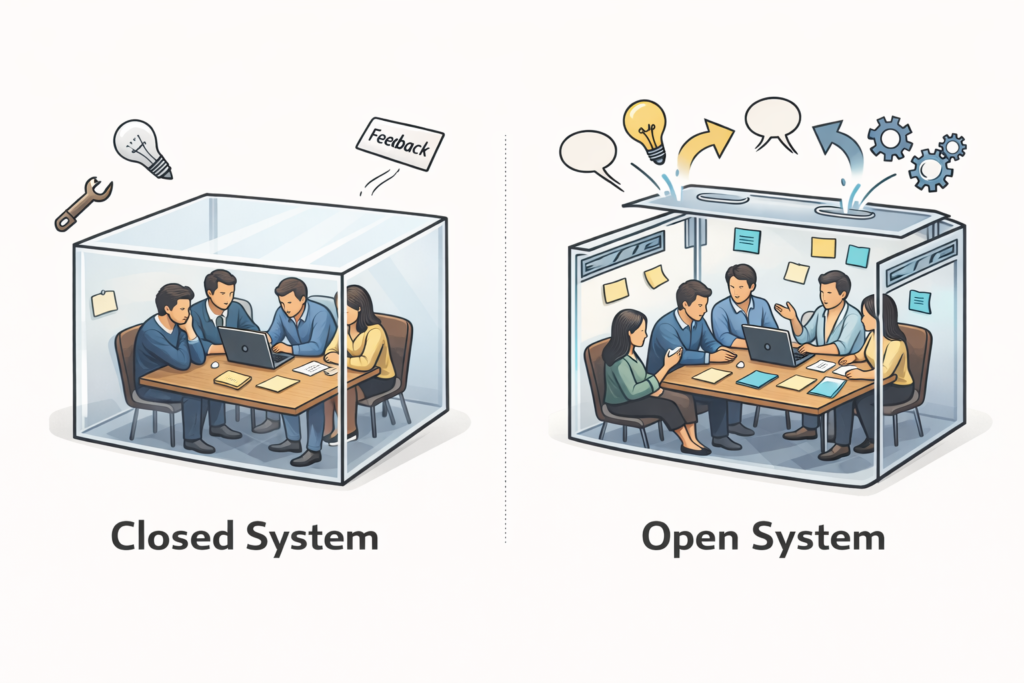
A workplace turns into a closed system when it starts protecting itself from reality.
Not intentionally. Not with a memo.
It happens gradually:
- Feedback gets filtered on the way up
- Dissent becomes “negative attitude”
- Group thinking replaces genuine debate
- People learn what’s safe to say
- The status quo becomes the default setting
From the outside, everything can still look fine. Meetings still happen. Reports still get produced. Targets still get discussed.
But inside, entropy begins to rise.
What organizational entropy looks like ?
When entropy shows up in a company, it usually doesn’t arrive as a dramatic crisis.
It arrives as strategic drift.
Small symptoms that slowly become normal:
- Decisions get slower
Because everyone is managing risk, reputation, and politics—not just solving the problem. - Reality gets edited
Bad news is softened. Metrics are curated. People tell leaders what they think leaders want to hear. - Innovation drops
Not because people lack ideas—but because ideas create friction, and friction becomes dangerous. - Performance quietly deteriorates
The organization keeps moving… but it’s moving off course.
And by the time everyone agrees there’s a problem, the gap is already big.
This is why some organizations don’t “fail” suddenly.
They decay slowly—until the bill comes due.
Why this happens even with good people ?
Most organizations don’t decline because their employees are bad.
They decline because the system becomes sealed.
In a sealed system:
- Truth has no oxygen
- Learning slows down
- Weak assumptions survive too long
- Complexity grows unchecked
- Small issues accumulate into structural failure
Entropy doesn’t need villains.
It only needs silence.
The antidote: intentional “energy” from the outside
In physics, the way you reduce entropy is by adding energy.
In organizations, the “energy” isn’t chaos.
It’s productive challenge—the kind that keeps the system open, honest, and adaptive.
That energy looks like:
- New ideas entering the system (fresh eyes, new talent, cross-functional exposure)
- Honest feedback loops (especially upward feedback that doesn’t get punished)
- Healthy friction in meetings (debate that improves decisions, not debate that damages people)
- Diverse mindsets solving problems together (diversity of thinking, not just diversity on paper)
- Leaders who invite hard truths early (before reality forces it later)
The strongest organizations don’t avoid tension.
They design safe ways to use tension well.
A simple test: “Are we open—or sealed?
Here are a few questions any leadership team can ask:
- Do people bring problems early—or only when they’re impossible to hide?
- In meetings, do we debate ideas—or perform agreement?
- Are we getting raw feedback—or polished updates?
- When someone challenges a plan, are they rewarded—or labeled?
- Are we learning faster than our environment is changing?
If the answers feel uncomfortable, that’s not a sign of failure.
That’s a sign you still have time.
Organizations rarely fail because people are bad.
They fail because the system becomes sealed…
and entropy does what entropy does.
The solution isn’t louder motivation.
It’s designing a culture that stays open to reality, open to challenge, and open to learning—before disorder becomes destiny.
Keep your systems open, or your strategy will drift.
The $5 Glove That Cost $5,000: A Lesson in Systems Thinking for Healthcare