I’m writing this looking out my office window at the road below. It’s a perfect, real-time illustration of a challenge we face every day inside our hospital walls regarding hospital flow.
On one side of the road, traffic is free-flowing. Cars are moving with purpose, steadily heading toward their destinations. On the other side, it is absolute gridlock. Brake lights are on, engines are idling, and drivers are stuck, inching forward with no sense of when the congestion will break.
It struck me that this is exactly what “Patient Flow” looks like.
We often talk about flow in terms of metrics, bed turns, and operational efficiency. But if we want to truly understand the impact of flow, we need to look at it through the lens of the human beings traveling through our system.
Every car outside is a patient. And just like those drivers, every patient wants the same thing: to move safely and efficiently from “Point A” (sickness and admission) to “Point B” (health and discharge).
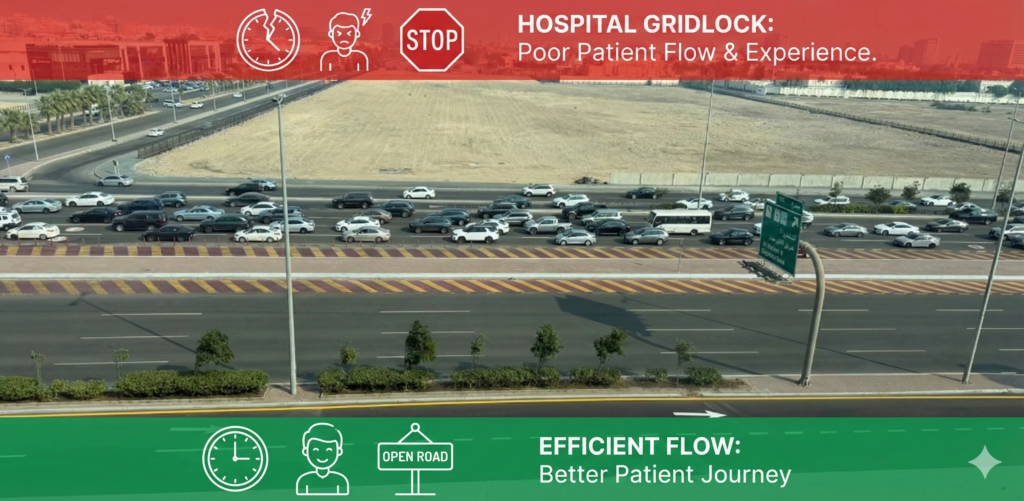
The Anatomy of a Gridlock: Obstacles vs. Volume
Why is that one lane stuck? In traffic, as in our hospital, there are usually two distinct reasons for the jam.
1. The Obstacle (The Process Failure) Sometimes, the road is blocked. It’s a poorly timed traffic light, construction closing a lane, or an accident up ahead.
- In the Hospital: This is the patient waiting four hours for a consult, the bed that sits dirty for two hours because EVS wasn’t notified, or the discharge delayed because a ride didn’t show up. These are the “potholes” and “red lights” we create ourselves.
2. The Rush Hour (Demand Exceeding Capacity) Other times, the road is clear, but the gridlock remains. Why? Because there are simply more cars than the lanes can handle at that specific moment. It is a mismatch of supply and demand.
- In the Hospital: This is the flu season surge, or Monday morning in the ED. It is when our patient volume spikes, but our number of beds and staff remains fixed. We haven’t “crashed,” but we are overwhelmed. And hospital flow is bad.
When either of these happen—or worse, when they happen at the same time—movement stops. We get gridlock.
The Emotional Toll of the Traffic Jam
We all know the feeling of being stuck in unmoving traffic. It is frustrating, anxiety-inducing, and deeply powerless. You cannot turn around; you cannot speed up. You are at the mercy of the road.
Now, imagine feeling that way while you are sick, in pain, or worried about a diagnosis.
When patient flow stagnates, the patient experience plummets. Even if the clinical care is excellent—even if the doctor is brilliant and the nurse is compassionate—the experience of waiting erodes trust.
For a patient stuck in hospital gridlock, the perception changes dramatically:
- Waiting feels like neglect: “Nobody knows what’s happening to me.”
- Stillness feels like danger: “Why aren’t I getting better yet?”
- Overcrowding feels unsafe: “They are too busy to care for me properly.”
Furthermore, just as stalled traffic increases the risk of fender benders, stalled patient flow increases the risk of medical error. When the “road” is over capacity, safety margins shrink.
The Open Road Experience
Now, look back at the free-flowing lane. Why does it work? It works because the system is managed proactively.
Good hospital flow isn’t about rushing patients out the door. It’s about two things: removing obstacles and smoothing the demand.
When we manage flow well, the patient experience transforms:
- Movement equals progress: The patient feels they are actively moving toward recovery.
- Predictability creates calm: Knowing the plan reduces anxiety and lowers blood pressure.
- Confidence in Capacity: Even during a “rush hour,” if patients see organized movement, they trust that the system can handle their needs.
We Are the Road Engineers
The crucial takeaway from the window view is this: We cannot always control the volume of cars (patients) entering our highway. We cannot build new lanes (beds) overnight.
However, we can control how we manage the traffic.
- We fix the potholes: We eliminate the delays in testing, cleaning, and discharging to keep the lanes we do have moving fast.
- We manage the rush hour: We anticipate surges, discharge earlier in the day to free up space before the “evening commute” arrives, and smooth out the peaks.
Improving patient experience isn’t just about nicer pillows or better food. Those are amenities. The core of a great experience is a system that respects the patient’s time and urgency.
Let’s keep the traffic moving.
The $5 Glove That Cost $5,000: A Lesson in Systems Thinking for Healthcare