In many organizations, especially healthcare, there is enormous pressure to become “more efficient.”
Reduce waiting times. Increase throughput. Cut delays. Improve utilization. Do more with less.
But there is a critical question that often gets ignored:
Are we becoming more efficient at doing the wrong things?
Efficiency without effectiveness can accelerate waste, amplify poor processes, and create the illusion of progress while moving further away from meaningful outcomes.
Before asking “How can we do this faster?” we must first ask:
“Is this the right thing to do in the first place?”
That is the essence of prioritizing effectiveness before efficiency.
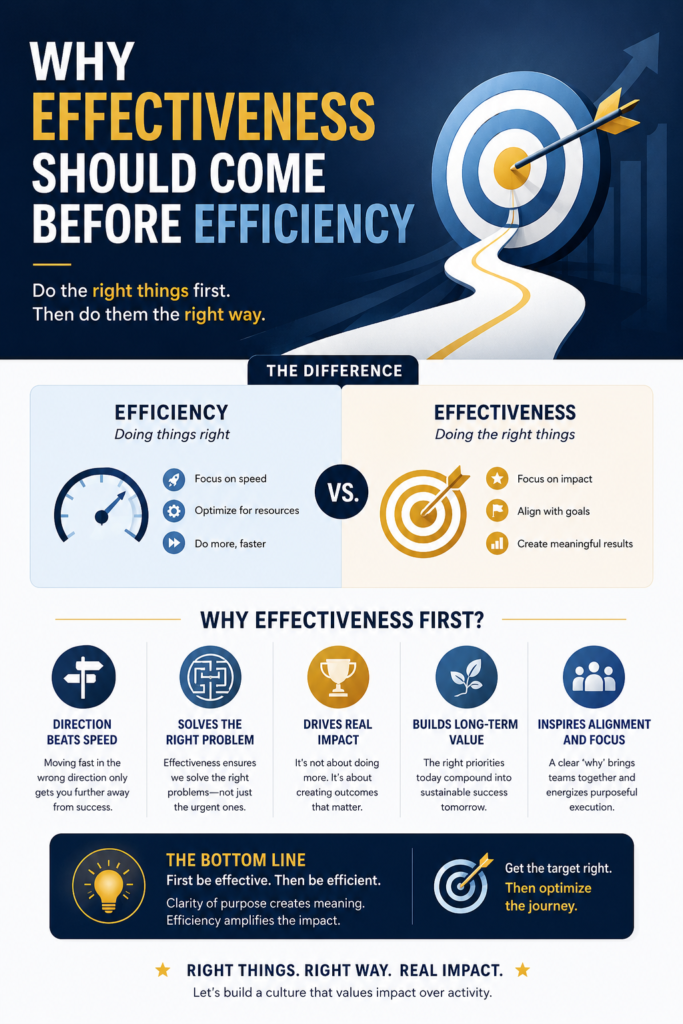
Understanding the Difference
Effectiveness
Doing the right things
It focuses on:
- Purpose
- Outcomes
- Patient value
- Strategic alignment
- Solving the correct problem
Efficiency
Doing things right
It focuses on:
- Speed
- Optimization
- Resource utilization
- Reducing waste
- Standardization
Both matter.
But in the wrong order, efficiency becomes dangerous.
Why This Matters So Much in Healthcare
Healthcare is not a factory producing identical products.
It is a complex adaptive system dealing with human lives, uncertainty, emotions, and variation.
When healthcare organizations pursue efficiency before effectiveness, several problems emerge:
- Faster patient movement without improving patient outcomes
- More documentation with less meaningful care
- Increased staff burnout
- Better-looking KPIs but worse patient experience
- Technology implementations that digitize broken processes
In other words:
We become extremely efficient at sustaining problems.
Example 1: Emergency Department Flow
A hospital notices long waiting times in the Emergency Department.
The immediate reaction:
- Increase triage speed
- Push physicians to see more patients per hour
- Add dashboards tracking “door-to-doctor” time
- Accelerate patient disposition
These are efficiency-focused actions.
But what if the real issue is:
- Poor inpatient bed availability
- Delayed discharge processes
- Unnecessary admissions
- Lack of standardized escalation pathways
If the organization only improves front-end speed without solving these underlying systemic issues, the result may be:
- Crowded hallways
- Staff frustration
- Increased rework
- Higher clinical risk
The ED becomes more efficient at transferring congestion downstream.
Effectiveness-first thinking asks:
- What problem are we truly solving?
- What creates value for the patient?
- Where is the system constraint?
- Are we improving flow or just movement?
Only after identifying the correct intervention does efficiency become meaningful.
Example 2: Digital Transformation in Healthcare
Many hospitals invest heavily in technology expecting instant improvement.
A common mistake:
Automating a bad process.
For example:
- A complex medication approval workflow already contains unnecessary steps
- Instead of redesigning the workflow, the organization digitizes it exactly as it exists
Now staff can complete wasteful steps faster.
The process becomes more efficient.
But not more effective.
The result?
- Increased clicks
- User frustration
- Alert fatigue
- Reduced clinician satisfaction
Technology should not merely speed up existing work.
It should help organizations rethink:
- Why the process exists
- Which steps add value
- What can be eliminated
- What improves patient care and safety
Example 3: KPI Obsession
Healthcare organizations often monitor:
- Number of patients seen
- Average Length of Stay
- Operating Room utilization
- Turnaround times
These are important operational measures.
But if leaders focus only on numerical efficiency, teams may unintentionally optimize the metric rather than the outcome.
For example:
- Discharging patients too early to reduce LOS
- Rushing consultations to improve throughput
- Scheduling more procedures while compromising staff capacity
A department may appear successful on paper while patient experience and employee morale deteriorate.
Effectiveness asks:
“Are we creating meaningful outcomes?”
Efficiency asks:
“How quickly can we do it?”
Healthcare requires both — but in the correct sequence.
Setting Up Something New: Why Effectiveness Matters First
When launching a new initiative, many organizations jump immediately into:
- SOPs
- Dashboards
- Timelines
- Reporting structures
- Automation
- Capacity calculations
But if the foundational purpose is unclear, the initiative becomes mechanically efficient yet strategically weak.
For example, while establishing:
- A patient flow command center
- A hospital-at-home model
- A quality improvement office
- A lean transformation program
- A virtual clinic service
The first question should never be:
“How do we scale this quickly?”
It should be:
“What problem are we truly trying to solve?”
Without clarity:
- Teams lose alignment
- Metrics become disconnected from value
- People focus on activity instead of impact
Effectiveness creates direction.
Efficiency amplifies direction.
If the direction is wrong, efficiency only gets you there faster.
The Leadership Perspective
One of the biggest leadership mistakes is rewarding busyness instead of meaningful contribution.
In healthcare especially, people are often overloaded with:
- Meetings
- Reports
- Emails
- Escalations
- Projects
- Data requests
Everyone appears productive.
But productivity is not the same as impact.
High-performing organizations are not the ones doing the most work.
They are the ones consistently focusing on the right work.
A Simple Analogy
Imagine rowing a boat with maximum efficiency.
Perfect synchronization.
Maximum speed.
Excellent coordination.
But the boat is heading in the wrong direction.
No amount of efficiency compensates for ineffective direction.
The Real Role of Efficiency
Efficiency is still essential.
Once we identify:
- The correct problem
- The right priorities
- The desired outcomes
- The value to the patient
Then efficiency becomes powerful.
At that stage, efficiency helps:
- Reduce waste
- Improve reliability
- Increase scalability
- Enhance consistency
- Lower burden on staff
Efficiency should amplify effectiveness — not replace it.
Final Thought
Healthcare does not improve simply because we move faster.
It improves when we:
- Solve the right problems
- Focus on meaningful outcomes
- Align work with patient value
- Create systems that support people
Only then should we optimize speed and resources.
Because:
Doing the wrong things efficiently is still waste.
Doing the right things effectively creates real impact.
Have you tried the Red Bead Experiement