Patients don’t arrive on a schedule that matches our rotas. Yet most hospitals still build capacity as if they do. Closing that gap through smarter healthcare capacity planning is one of the simplest, most overlooked ways to cut waiting times without adding a single new post.
A lesson manufacturing learned decades ago
In manufacturing, matching capacity to demand has been a core discipline for decades. Get it wrong in either direction and you pay for it.
- Too little capacity: work-in-progress piles up, lead times stretch, and customers wait.
- Too much capacity: machines and people sit idle, and cost rises with no gain in output.
Lean thinking taught factories to stop asking “How much capacity do we have?” and start asking “How much do we need, and when?” Healthcare runs on exactly the same physics. The inventory is simply human: patients in a waiting room.
Healthcare demand is never flat
Patient demand rises and falls through the day in fairly predictable waves. Look at almost any service line and you will see peaks and troughs rather than a straight line.
- Outpatients (OPD): arrivals surge mid-morning as clinics fill, then again after lunch.
- Diagnostics: imaging and lab requests track clinic and ward-round timing, so they bunch up behind them.
- Pharmacy: discharge and clinic prescriptions cluster late morning and mid-afternoon.
- Procedures: start times, turnovers and late-running lists create their own daily rhythm.
- Admissions: emergency and elective admissions often peak in the afternoon, just as beds are still waiting on discharges.
These patterns are not random noise. They are data, and in most hospitals that data already sits in the scheduling, EMR and queue systems.
The fixed-shift trap
Despite those daily waves, many hospitals still plan capacity in flat, fixed blocks. You hear it in everyday planning language:
- “We have two doctors from 8 to 4.”
- “We have three nurses per shift.”
- “The department closes at 5.”
Each statement sounds reasonable on its own. Together they draw a straight line of capacity across a curved line of demand.
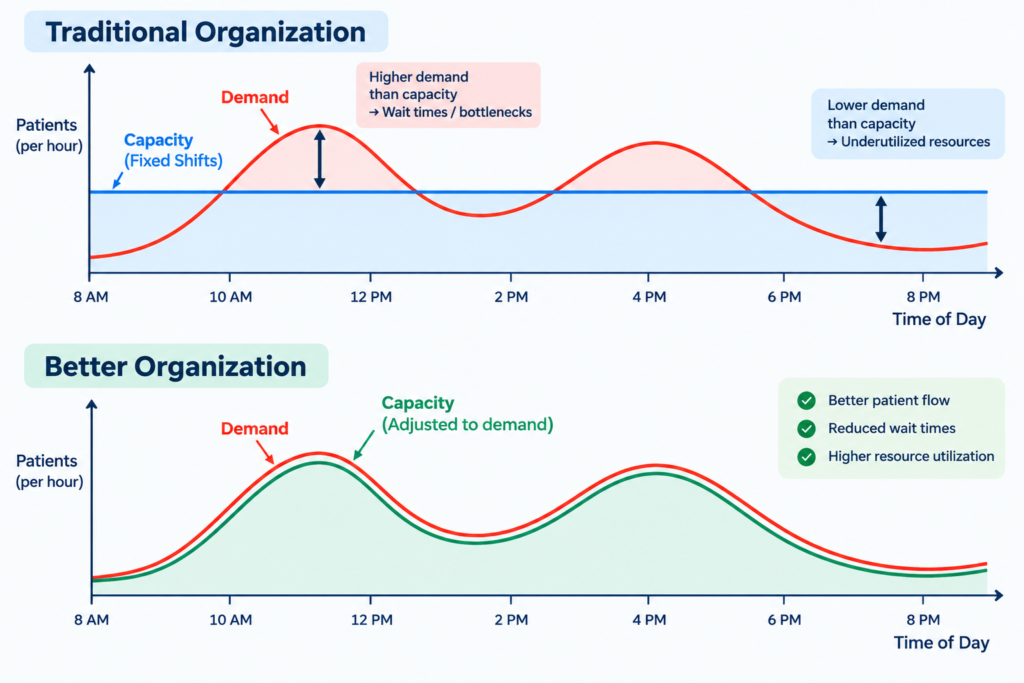
The top chart shows what happens next. Around the late-morning and mid-afternoon peaks, demand climbs above the fixed capacity line. Queues form, waits lengthen, and staff feel stretched and rushed.
In the quieter windows, early morning, early afternoon and evening, the opposite happens. Capacity sits well above demand, and skilled people and expensive equipment are underused.
The frustrating part is that the total capacity across the day may be just right. It is simply in the wrong place at the wrong time. That is why “just add another doctor” so often raises cost without fixing the queue.
Healthcare capacity planning: from more capacity to responsive capacity
The bottom chart shows the alternative: capacity that rises and falls with demand. The opportunity is not to add capacity, but to make the capacity we already have more responsive. Six practical levers make that possible.
- Staggered shifts. Instead of everyone starting at 8, start times are spread so staffing builds towards the peak. A 7–3, 9–5 and 11–7 pattern can cover the same hours with far better alignment.
- Flexible staffing. Part-time, bank and on-call arrangements let teams scale up for known peaks and seasonal surges without carrying that cost all day.
- Cross-trained teams. When staff can safely work across two or three areas, they can move to where the queue is forming rather than waiting where it isn’t.
- Appointment slot optimization. Clinic templates are redesigned to smooth arrivals, for example by spreading new and follow-up patients evenly rather than booking everyone at the start of a session.
- Dynamic allocation of rooms and equipment. Consult rooms, scanners and procedure slots are assigned by real-time need, not by who “owns” them.
- Moving non-critical work to quieter periods. Documentation, audits, stock replenishment, training and non-urgent reporting shift into the troughs, freeing people at the peaks.
None of these levers needs a new building or a bigger budget. They need good data, clear standard work and the willingness to question how things have always been scheduled.
Where to start
You don’t need to redesign the whole hospital at once. Pick one service with a visible queue and work through five steps.
- Map demand by hour and weekday. Use several weeks of arrival or request data, not a single snapshot, so the real pattern shows through.
- Map capacity on the same chart. Plot staff, rooms and equipment actually available each hour, including breaks and handovers.
- Find the gaps. Mark where demand exceeds capacity, where capacity sits idle, and how large each gap is.
- Test one or two levers. Run a small, time-boxed trial, such as one staggered shift or one redesigned clinic template, and measure waits and utilisation before and after.
- Standardise and spread. Lock in what works through updated rotas and standard work, then repeat in the next service.
This is the Plan-Do-Study-Act cycle in practice: small, measured changes built on real demand data.
From managing queues to designing flow
The goal isn’t maximum capacity. The goal is the right capacity, at the right time, in the right place.
When capacity follows demand, patients move through the system with fewer delays. Staff work at a steadier, safer pace instead of swinging between overload and idle time. And the hospital gets more value from resources it has already paid for.
That is the real shift: from managing queues after they form to designing flow so they don’t form in the first place.