If your car had no shock absorbers, a tiny pothole would snap your axle. If your calendar had zero spare minutes, a single red light would ruin your entire day. And if you run out of cash, one unexpected car repair triggers a financial crisis.
We rely on these hidden cushions—buffers—every day. They are the extra space, time, or money we keep around to absorb the unpredictable bumps of real life.
But nowhere is the design of buffers more critical—or more poorly understood—than in a hospital.
Why Hospitals Need Buffers More Than Other Industries ?
In manufacturing, uncertainty can often be absorbed through inventory. If demand suddenly increases, a factory can ship products from a warehouse.
Healthcare is different.
You cannot
- store extra ICU capacity on a shelf.
- manufacture an experienced emergency nurse in an afternoon.
- save a surgeon’s availability in a warehouse for tomorrow.
When a hospital runs out of buffer, the consequences are not delayed deliveries or unhappy customers.
- Patients wait.
- Surgeries are postponed.
- Staff experience constant firefighting.
- Clinical risk increases.
The challenge for healthcare leaders is therefore not: “How do we eliminate unused capacity?”
The better question is: “How much capacity do we need available to absorb the uncertainty that comes with caring for human beings?”
So how do healthcare leaders balance efficiency with safety?
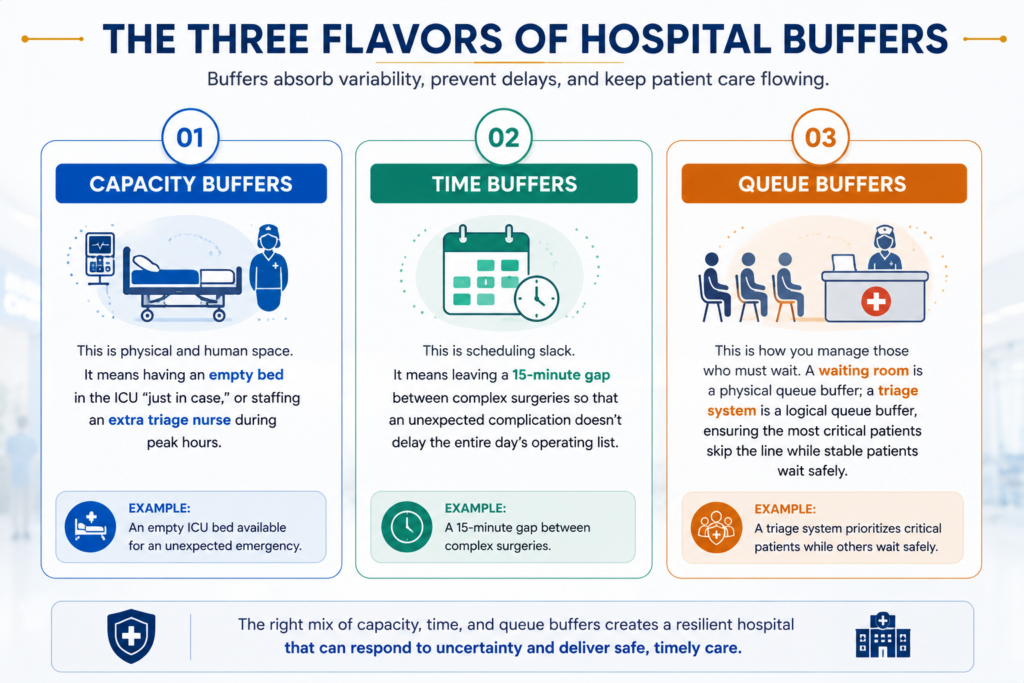
Before we can size a buffer, we need to know what kind of buffer we are building. In healthcare operations, buffers come in three distinct forms.
The Three Flavors of Hospital Buffers
The Core Question: How Much Buffer Is Enough?
The eternal battle in hospital management is between financial efficiency (which wants resources used at 100% capacity) and clinical safety (which needs spare capacity to handle surges).
To solve this, operations experts turn to queueing theory, and specifically to Kingman’s Formula.
The equation calculates the expected wait time in a queue by multiplying three distinct metrics:
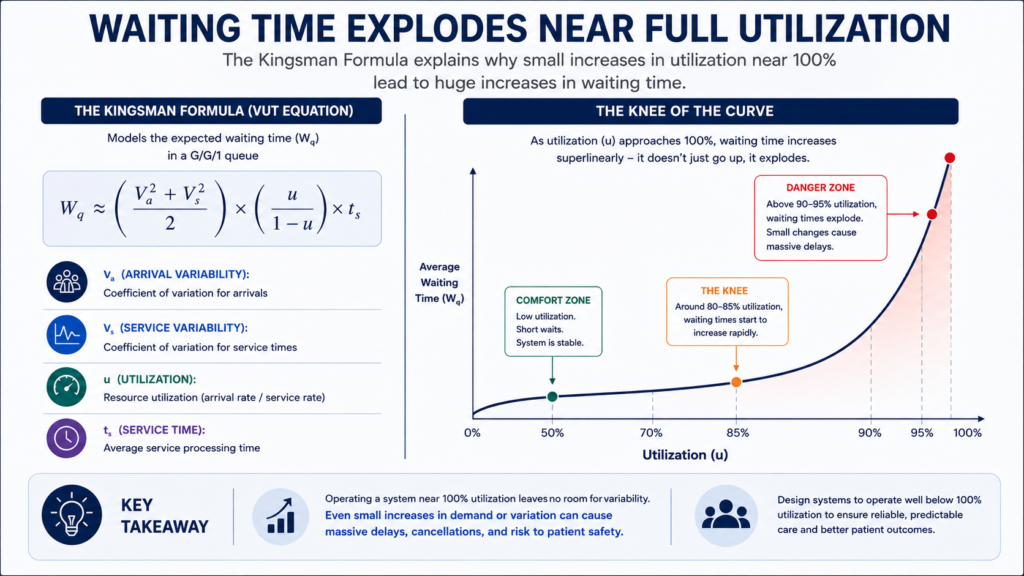
The formula proves mathematically why running a hospital at 100% capacity is impossible. It defines the average waiting time in any queueing system:
Here is what drives the chaos:
- Arrival Variability: How randomly patients show up (e.g., highly unpredictable in the ER).
- Service Variability: How wildly treatment times vary (e.g., a 5-minute stitch vs. a 4-hour trauma).
- Utilization: How busy the system is (e.g., percentage of beds full).
- Service Time: The average time a patient needs care.
The “Knee of the Curve”
Look closely at the middle of Kingman’s formula:
As utilization increases, this value rises rapidly. At ..
- 50 % utilization , the system has plenty of breathing room.
- 85%, pressure begins to build.
- 95–100%, even small variations create major delays.
This is known as the knee of the curve — the point where a system moves from stable flow into chronic congestion.
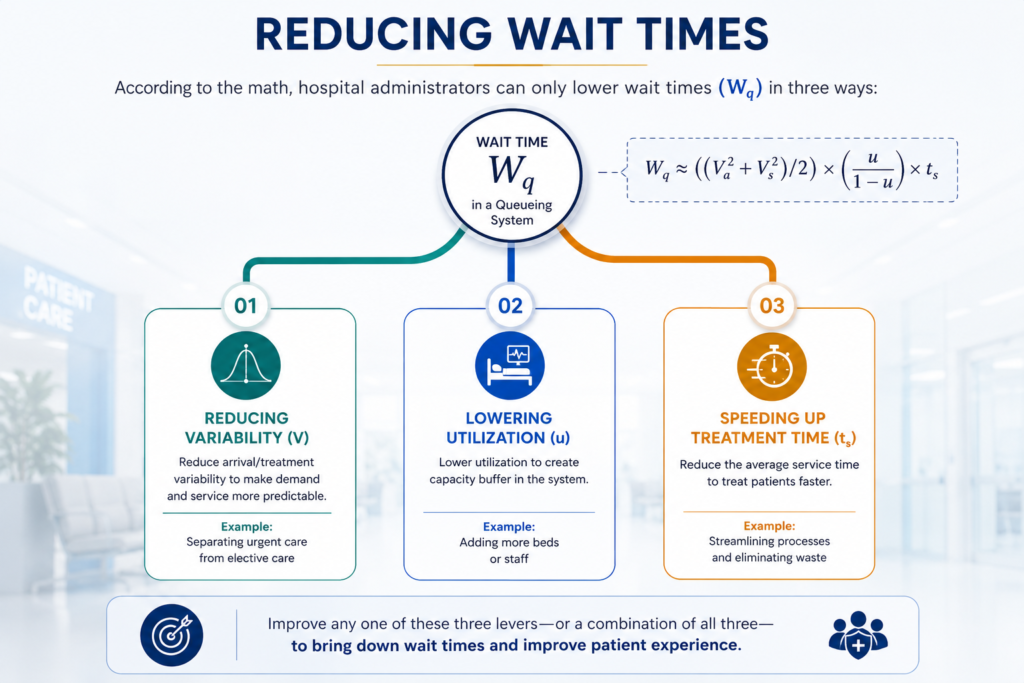
Reducing Wait Times:
According to the math, hospital administrators can only lower wait times in three ways:
The 85% Rule and the Asymmetry of Risk
So, where should a hospital operate?
For decades, hospital planners have relied on the 85% Rule. Queueing models show that for a typical inpatient medical-surgical ward, average occupancy should not exceed 85%. That remaining 15% is your capacity buffer. Push past 85%, and you hit the knee of the curve: patients begin boarding in the emergency department because there are no clean beds upstairs.
However, sizing buffers isn’t just about math; it’s about the cost of failure.
- In an Outpatient Clinic: The cost of under-buffering is a patient waiting 30 extra minutes reading a magazine. Elective clinics can often safely run at 90–95% utilization.
- In an ICU: The cost of under-buffering is a critical patient waiting in a hallway without a ventilator. Because the cost of failure is catastrophic, high-risk units require larger buffers, often operating safely around 70–75% average occupancy to guarantee a bed is open when a trauma arrives.
Designing the Right Buffer: A Practical Approach
Buffers should not be based on guesswork. They should be engineered.
Step 1: Understand Your Variability
Start by measuring variation.
An emergency department experiences:
- Unpredictable arrivals
- Highly variable patient complexity
- Uncertain treatment times
It therefore requires significant buffering.
A planned imaging service with controlled appointments and predictable processes requires much less.
The buffer should match the variability ( and ).
Step 2: Understand the Cost of Running Out of Buffer
Not all failures are equal.
Running out of buffer in an outpatient clinic may mean a longer wait.
Running out of buffer in an ICU may mean a critically ill patient has nowhere appropriate to go.
The cost of failure determines the size of protection required.
Step 3: Build Dynamic Buffers
Instead of keeping a static 20% empty bed buffer 24/7—which is incredibly expensive—modern hospitals use dynamic buffering. They set up escalation tiers:
- When ED occupancy hits 80%, an automated alert triggers standard operations.
- When it hits 95%, a “flex pool” of on-call nurses is activated.
- When it hits 105% (hallway boarding), elective surgeries are automatically postponed to free up inpatient beds.
This is the hospital equivalent of deploying extra shock absorbers only when the road gets rocky.
The aim is not to keep the system empty.
The aim is to keep it resilient.
The Takeaway
A hospital running at 100% capacity may look efficient on a spreadsheet.
But healthcare is not a spreadsheet.
It is a complex, variable system where uncertainty is unavoidable.
Buffers are often misunderstood as waste.
They are not.
A buffer is what allows a system to absorb variation without transferring that variation to patients and staff.
A car without shock absorbers cannot handle a rough road.
A hospital without operational buffers cannot handle the unpredictability of caring for people.
The goal is not maximum utilization.
The goal is reliable flow, patient safety, and a system that performs well even when the unexpected happens.
In high-stakes, highly variable environments, buffers are the very mechanism that creates safety, reliability, and flow. You don’t want a hospital running at 100% capacity any more than you want to drive a car with no suspension.
📌 Technical Note: Single-Server Math in a Multi-Server World
For the systems engineers and continuous improvement practitioners reading this, you might have noticed that Kingman’s formula describes a single-server system (mathematically, a queue). It assumes one line of patients waiting for one single resource.
However, hospitals are incredibly complex multi-server systems (modeled as or queues). An inpatient ward has dozens of beds (servers), and an Emergency Department has multiple providers working simultaneously.
So, why use a single-server formula to explain hospital operations?
1. The Power of Resource Pooling
In reality, if you ran a highly variable single-server clinic at 85% utilization, the wait times would be disastrous. Hospitals can safely target 80–85% utilization precisely because of resource pooling. Having multiple beds or doctors absorbs variation much better than a single server, effectively pushing the “knee of the curve” further to the right.
2. Conceptual Clarity Over Complex Summations
The exact mathematics for a multi-server system with high variability require complex Erlang-C summations and variance approximations that can quickly obscure the main point. Kingman’s approximation perfectly isolates the three universal drivers of delay without the heavy matrix algebra:
- Arrival and Service Variation ( and )
- Average Service Time ()
- Utilization ()
Even in a 50-bed multi-server system, the underlying physics remain exactly the same. As utilization creeps toward 100%, the wait time still undergoes that exact same exponential explosion driven by the relationship. Kingman’s formula remains the most elegant way to visualize why operating at maximum capacity is a mathematical impossibility.